Our spending habits matter, but it’s not just about investing our money. How do we get our time to pay us dividends?
Want content like this in your inbox each week? Leave your email here.
Our spending habits matter, but it’s not just about investing our money. How do we get our time to pay us dividends?
Want content like this in your inbox each week? Leave your email here.


by Mark Leibman, Advisor
Thirty years ago this month, I sat down at the kitchen table and went to work—Day One—in Leibman Financial Services. I’d had the idea for more than a decade that I could assemble a group of clients, who, if I took care of them, they would take care of me. At age 40, it was time to test the theory.
The stakes were high. My life in financial services had been transactional up to that point. I knew if I did not change, I might wake up at sixty years old, needing to run up and down the highway to make a deal to pay for groceries. A sales mindset was not sustainable.
Getting serious about managing portfolios for people meant that my business objective could be simplified into this: grow the clients’ buckets.
It was hard, starting from scratch. We struggled and juggled for years. But business began to compound. Investment returns grew client balances, which grew revenue. Four years in, the quaint office building at 228 Main in beautiful downtown Louisville came available. I could neither afford it, nor afford to pass it up, so you know what I did!
Business doubled. And doubled. And doubled. And doubled. It turns out people like it when the focus is on growing their buckets.
The one-man band became a team of eight, eventually. I’m well down the path of working to age 92, with the enterprise around me that makes it possible. (Hey, Dylan is touring at age 85! I’m only 70.)
In this 30th anniversary month, I’m thinking of you, clients, grateful for your part in this glorious journey. Here’s to the next 30.
All investing involves risk including loss of principal. No strategy assures success or protects against loss. Past performance is no guarantee of future results.
Play the audio version of this post below:


People or companies may confer benefits on third parties without cost, as a side effect or byproduct of their actions. Planting a tree improves the neighborhood and provides shade to a neighbor. Keeping bees results in the pollination of nearby crops. Providing first-aid training to workers may save lives outside of work. A video or blog post created for clients might contain an idea that helps people who are not clients.
These are examples of what economists call positive externalities. These things are all good. They make the world a better place.
I believe the concept applies in our interactions with others, as well. Have you ever had your day brightened by the laughter of a group of passersby? Watched someone hold a door for someone with an armload of packages? Overheard a “thank you” being given for an otherwise thankless task?
All of these things are benefits that they produced for free and you enjoyed at no extra cost. They are positive externalities, on the small scale of daily life.
Having a tree planted improves our home as well as the neighborhood, but generating positive externalities can also help us beyond business transactions. Friends and family members respond to the empathy, kindness, and thoughtfulness embedded in any of those little actions we can take. If employed, those in our network are likely to sense the intangibles we add to the workplace environment. Our teammates across the community likely enjoy our interactions more.
Generating positive externalities is not charity. There are no costs involved, only benefits for giver, recipient, and neighbors and passersby. Win-win-win.
The general concept has been around for a long time, and is often expressed more simply. Be kind. Fill up the buckets of others. Do unto others.
Clients, if you would like to talk about this or anything else, please email us or call.
Want content like this in your inbox each week? Leave your email here.
Play the audio version of this post below:
No matter how beautiful, some flowers still have thorns. And no matter how flashy, some salespeople will have them too. Remember that not every person you meet will have your best interest at heart. Don’t let any peddlers dazzle you with diamonds! It never hurts to ask for a second opinion.
Want content like this in your inbox each week? Leave your email here.
“Well begun is half done,” the proverb says. And we tend to agree. Since it’s your journey, we don’t like to sweat the particulars: it’s never too early to start, but it’s also never too late.
Want content like this in your inbox each week? Leave your email here.
The most pertinent warning for investors in the AI age might be, “Trends may not persist.”
We humans tend to believe that current conditions or trends will continue. In recessions, we can scarcely imagine how the economy will ever recover. And when the markets get into bubble territory, it seems the good times will never end.
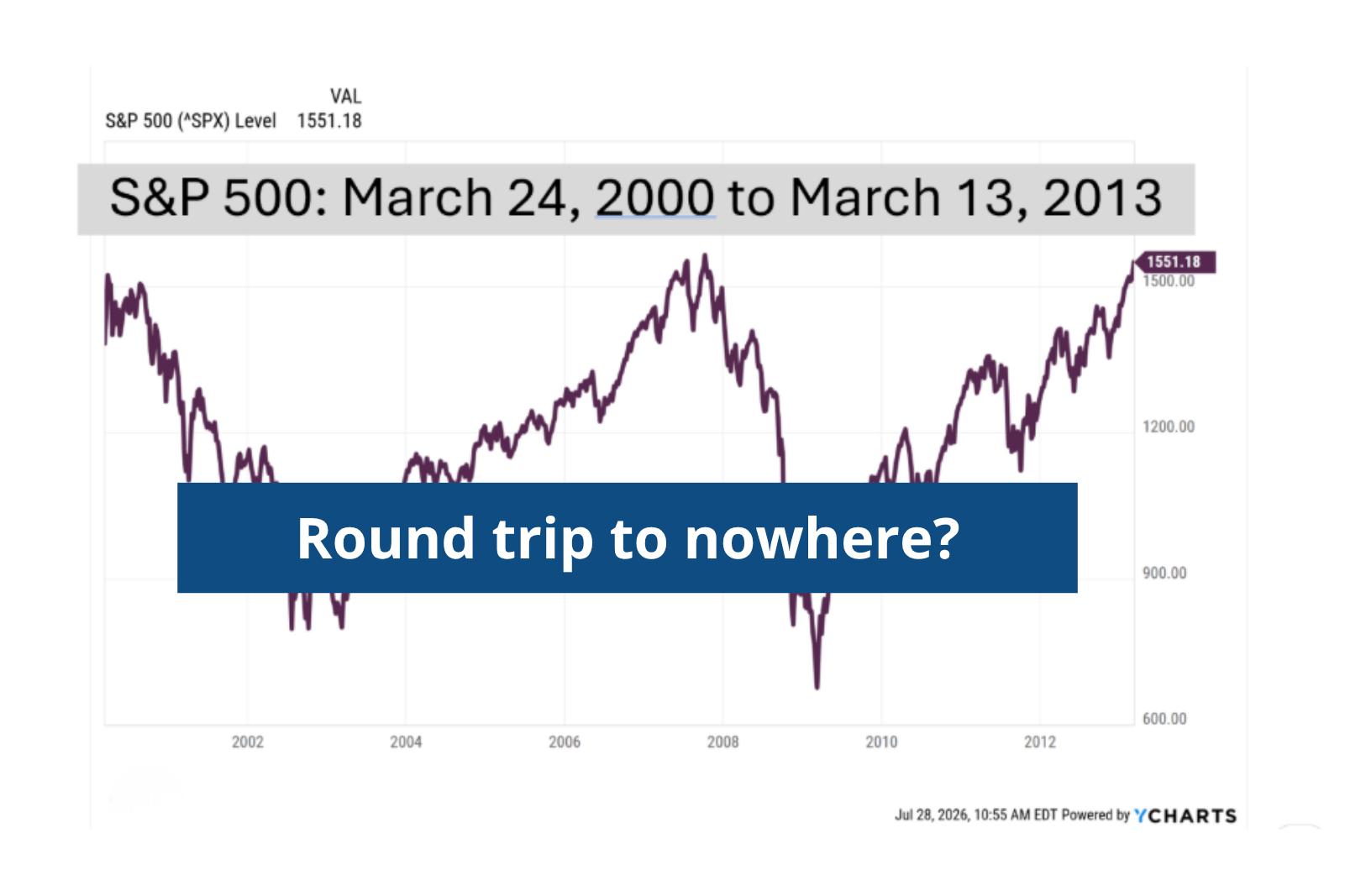
That was certainly the case in March of 2000, at the peak of the Internet Boom. The S&P 500 had basically tripled in five years and became dominated by large technology companies.
“The internet was going to change everything,” they said—and that story came true.
But valuations had gotten so excessive, the S&P 500 suffered a Lost Decade when the trend changed: it took nearly 13 years on a round trip to nowhere. Fortunately, the S&P 500, composed of the stocks of large U.S. companies, is not the only game in town. Small and mid-sized companies, value stocks, international companies, and other opportunities held up much better, sometimes even making gains during the flat spell.
This history lesson is key to why we are not chasing the index here at 228 Main, especially right now. Looking for bargains, avoiding stampedes—these fundamental principles help us avoid the extremes. Most of us don’t have thirteen years to wait for a market recovery, so it makes sense to strive to be in those parts of the investment universe that are more reasonably priced, now.
As in 2000, the index has become dominated by large technology companies, this time as part of the AI boom. We are paying attention to our principles, mindful that these trends may not persist.
We pay, temporarily, in performance. Our approach has us lagging the S&P 500 recently; we’re not going up by as much, but our efforts now are made in an attempt to potentially go down by less when the bust comes. No guarantees. But we’re turning to history as a guide.
Clients, now as ever, reach out any time with your questions. We’re here to help.
Neither the past performance of the S&P, nor the described methodology, is a guarantee of future returns.
Content in this material is for general information only and not intended to provide specific advice or recommendations for any individual. All indices are unmanaged and may not be invested into directly.
All investing involves risk including loss of principal. No strategy assures success or protects against loss.
Want content like this in your inbox each week? Leave your email here.
Play the audio version of this post below:
It’s not as simple as “us” and “them.” Whether it’s politics, social issues, or economics, there are real costs when we forget the fundamental truth: we are all connected. This week Mark takes a thoughtful look at how our choices and lives are tied to one another. What’s the future we want to build, together
Want content like this in your inbox each week? Leave your email here.

by Mark Leibman, Advisor
I learned how to make soup back in the last chapter. Now a variety of soups are a staple of my diet.
Crafting a new soup recipe recently, I started with a chicken, six herbs and spices, and seven kinds of vegetables. I used some olive oil and a splash of red wine vinegar. It may be served with a mix of seven kinds of beans, and rice, of course (you know how I feel about rice and beans!).
It came out really good!—according to a biased observer that I recently married.
Contemplating the choices made in the creation of the soup, I thought about how we build portfolios here at 228 Main.
From many alternatives, we select what we want to own and determine the proportions of each. Another school of thought holds that portfolios should consist of some of everything—500 stocks go into the S&P 500 index, for example, so portfolios get to hold a little of each.
That led me to wonder, What would Index Soup look like?
And it might even be served with 25 kinds of beans, and 10 varieties of rice!
That would have to taste like a little bit of everything, and not much of anything, wouldn’t it?
Just as different recipes can reflect a wide variety of tastes and textures and smells, and we humans have an appetite for different things at different times, our portfolios evolve and change as conditions unfold.
By looking for the best bargains, by avoiding stampedes in the market, by planning to own the orchard for the fruit crop (thinking long-term), our collection of opportunities has diverged from the most popular kind of Index Soup, the S&P 500.
Creating our own recipe helps avoid another possible pitfall of Index Soup—not that it can get too bland in its attempt to average everything, but that it can get too heavy-handed in spicy times.
Recently, slightly more than half of our long-term portfolios are invested in small- and mid-size companies. We’re diversified around the world, although about two-thirds of value is still invested in the U.S. While AI-related stocks have captured the public imagination, we’re focused a little more on value-style stocks than the mega-size growth companies, which we believe may be over-valued at present. No guarantees, but we’re trying to be intentional with our flavors.
Meanwhile, Index Soup focuses on large U.S. companies, with an emphasis on growth. Technology is nearly 37% of the mix in that soup, and the top seven holdings are mega-size tech companies.
We know that the flavor can get “too strong” at times: back in the year 2000, the S&P 500 index, and technology stocks generally, left a bad taste in the mouths of many investors the last time valuations approached extreme levels.
We can’t know the future, but we are hopeful our recipe is going to “taste” a lot better in the months and years ahead. No guarantees—past performance is not an indicator of future results.
But we don’t have to be the best chefs in the world. We’re just trying to find a blend that works for us.
Want content like this in your inbox each week? Leave your email here.
Investing involves risk including the loss of principal. There is no assurance that the views or strategies discussed are suitable for all investors or will yield positive outcomes.
The opinions voiced in this material are for general information only and are not intended to provide specific advice or recommendations for any individual. There is no guarantee that a diversified portfolio will enhance overall returns or outperform a non-diversified portfolio. Diversification does not protect against market risk.
The S&P 500 is an unmanaged index which cannot be invested into directly. Past performance is no guarantee of future results.
Play the audio version of this post below:


by Whitney Engle, Client Services Coordinator
We were talking as a team the other day when Mark brought up a vivid memory from his first summertime job. He worked at Peony Park in Omaha, Nebraska, an entertainment venue that included everything from an amusement park and a swimming pool with a third of a mile of beach, to a dance hall and picnic grounds.
You’d think the first memory to flood back might have been a thrill ride or the Sprite Nite dances. But Mark remembered something else.
Walking through the park each day to get to work at the pool, Mark passed an old fellow, dressed in overalls, working in the flower beds. Day in and day out, the man tended the garden. For a long time, Mark didn’t know what he was witnessing.
Turns out, the Malec family’s early businesses capitalized on a neighboring peony farm: Joe Malec, now of the overalls, was one of three brothers who started what became Peony Park. Fifty years later, it had blossomed into a major force in the community.
As a kid, Mark found it odd. Wouldn’t a founder have more important things to do?
With age comes wisdom. Fast-forward another fifty years: Mark understands why Joe was in the flower beds. Between his own efforts and the help of his descendants, Joe found the freedom to focus on what he enjoyed the most. Sure, tending the flowers wasn’t the flashiest work, but that is how he wanted to spend his time.
Mark doesn’t have overalls, but he too gets to “tend the flowers” now, doing what he loves most: talking with you and trying to find new investment opportunities. He spends half his time in Louisville, the other half working from afar—focusing more on making memories and building relationships.
Leibman Financial Services is now a team of seven, so Mark no longer has to be a jack of all trades. You can reach out to any one of our advisors to get the same service and care as if you were talking to the founder himself. So, if you ever try to schedule a meeting with Mark and he’s not available right away, please remember that just like a farm, the firm is a team activity.
Doing work you love, for a living, is a true blessing. Thank you for being a part of our story.
Want content like this in your inbox each week? Leave your email here.
Play the audio version of this post below:
How do you measure a year in the life? Our former CEO Mark Leibman is celebrating a handful of exciting milestones! We’d love for you to take a minute to hear all about it from Mark himself.
Want content like this in your inbox each week? Leave your email here.
You must be logged in to post a comment.