Clients, there is a new friendly face that recently joined our team. Let us take a moment to get everyone up to speed.
As our enterprise grows, so does our team!
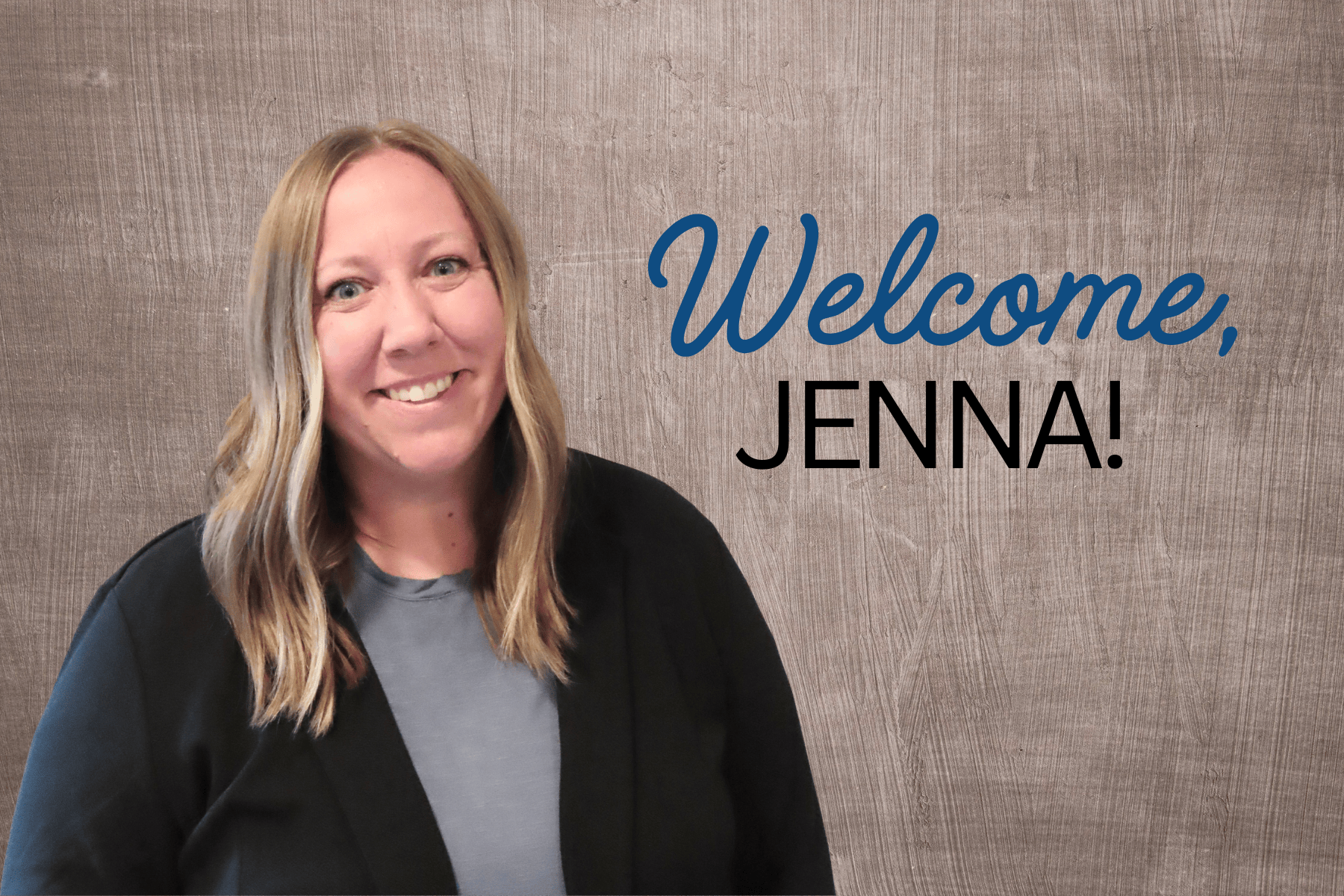
We’re pleased to introduce Jenna Groves, joining us as our newest Client Services Associate.
We believe the core activities of our enterprise are investment research, portfolio management, and talking to you. But nothing happens until the details are handled, and they are crucial. So Jenna is joining our client services team—a team that plays a vital role.
Jenna brings years of experience working in banking and healthcare industries, so a passion for helping others is part of her DNA. We could tell right away that her attitude, values, and skillset were a great match for our needs. She tells us she’s excited to join our team that strives to put people first and help them feel supported and informed.
A Springfield native who has lived in Louisville for years now, Jenna fits right in here with our love of the outdoors. Her family includes her high school sweetheart and her 5-year-old son. And if you’re a fan of country music, she’d love to chat, as one of her favorite activities is attending country music concerts.
Jenna may be the latest addition to the 228 Main team, but she is already caught up on the “history” of our work here. The mission is the same for the whole team: we strive to grow your buckets. And that project takes all of us, from research and trading to paperwork and communications—it happens when all of us are ready to be of service to each other.
Come in and say hello if you have a chance. Welcome, Jenna!
Thirty years ago this month, I sat down at the kitchen table and went to work—Day One—in Leibman Financial Services. I’d had the idea for more than a decade that I could assemble a group of clients, who, if I took care of them, they would take care of me. At age 40, it was time to test the theory.
The stakes were high. My life in financial services had been transactional up to that point. I knew if I did not change, I might wake up at sixty years old, needing to run up and down the highway to make a deal to pay for groceries. A sales mindset was not sustainable.
Getting serious about managing portfolios for people meant that my business objective could be simplified into this: grow the clients’ buckets.
It was hard, starting from scratch. We struggled and juggled for years. But business began to compound. Investment returns grew client balances, which grew revenue. Four years in, the quaint office building at 228 Main in beautiful downtown Louisville came available. I could neither afford it, nor afford to pass it up, so you know what I did!
Business doubled. And doubled. And doubled. And doubled. It turns out people like it when the focus is on growing their buckets.
The one-man band became a team of eight, eventually. I’m well down the path of working to age 92, with the enterprise around me that makes it possible. (Hey, Dylan is touring at age 85! I’m only 70.)
In this 30th anniversary month, I’m thinking of you, clients, grateful for your part in this glorious journey. Here’s to the next 30.
All investing involves risk including loss of principal. No strategy assures success or protects against loss. Past performance is no guarantee of future results.
The most pertinent warning for investors in the AI age might be, “Trends may not persist.”
We humans tend to believe that current conditions or trends will continue. In recessions, we can scarcely imagine how the economy will ever recover. And when the markets get into bubble territory, it seems the good times will never end.
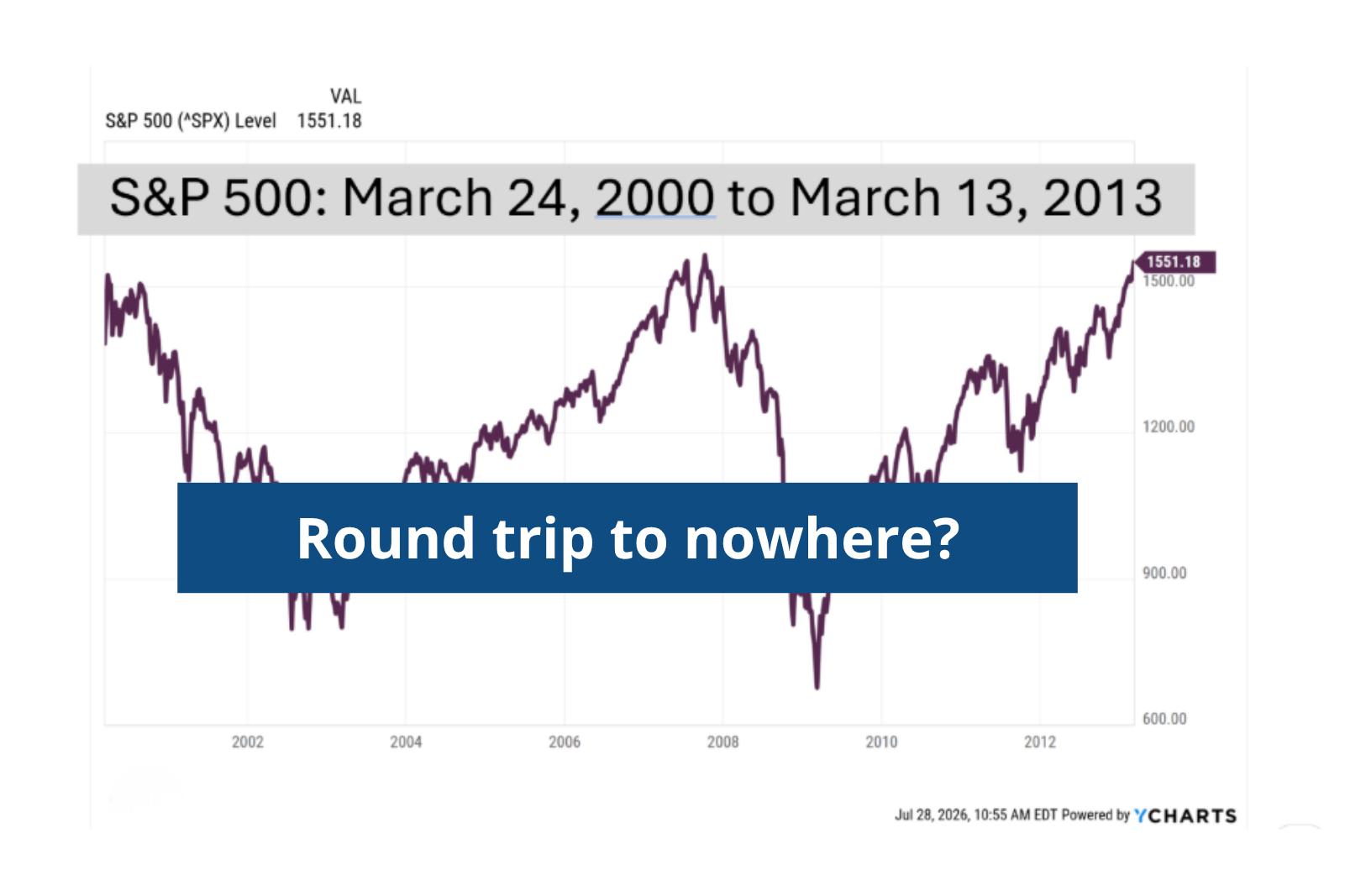
That was certainly the case in March of 2000, at the peak of the Internet Boom. The S&P 500 had basically tripled in five years and became dominated by large technology companies.
“The internet was going to change everything,” they said—and that story came true.
But valuations had gotten so excessive, the S&P 500 suffered a Lost Decade when the trend changed: it took nearly 13 years on a round trip to nowhere. Fortunately, the S&P 500, composed of the stocks of large U.S. companies, is not the only game in town. Small and mid-sized companies, value stocks, international companies, and other opportunities held up much better, sometimes even making gains during the flat spell.
This history lesson is key to why we are not chasing the index here at 228 Main, especially right now. Looking for bargains, avoiding stampedes—these fundamental principles help us avoid the extremes. Most of us don’t have thirteen years to wait for a market recovery, so it makes sense to strive to be in those parts of the investment universe that are more reasonably priced, now.
As in 2000, the index has become dominated by large technology companies, this time as part of the AI boom. We are paying attention to our principles, mindful that these trends may not persist.
We pay, temporarily, in performance. Our approach has us lagging the S&P 500 recently; we’re not going up by as much, but our efforts now are made in an attempt to potentially go down by less when the bust comes. No guarantees. But we’re turning to history as a guide.
Clients, now as ever, reach out any time with your questions. We’re here to help.
Neither the past performance of the S&P, nor the described methodology, is a guarantee of future returns.
Content in this material is for general information only and not intended to provide specific advice or recommendations for any individual. All indices are unmanaged and may not be invested into directly.
All investing involves risk including loss of principal. No strategy assures success or protects against loss.
Want content like this in your inbox each week? Leave your email here.
In the finance industry, you will find an abundance of acronyms. From IRA to RMD and everything in between, we don’t expect you to keep track of all the acronyms, but there is one we wanted to break down with you here: the ABLE account.
What are ABLE accounts? They are tax-advantaged savings plan or investment option for individuals with disabilities who qualify.
Who is eligible?
Individuals are eligible to open an ABLE account if their disability began before age 46 and they meet the required severity of disability in one of two ways:
Receiving Supplemental Security Income or Receiving Social Security Disability Insurance benefits, or
Having a licensed physician sign a document including the diagnosis and notes stating they have “marked and severe” functional limitations that began before age 46.
What’s the purpose? The goal is to take advantage of tax-free growth potential and allow beneficiaries to save for qualified disability expenses, such as:
Housing
Transportation
Health
Education
Another benefit of ABLE accounts is they do not affect eligibility for benefits like SSI and Medicaid. Lots of public benefit programs restrict eligibility to people with less than $2,000 in countable resources (like cash or retirement accounts). With ABLE accounts, up to $100,000 can be excluded as a countable resource.
ABLE plans available vary by state. It’s recommended to review the plan of the state where you live first because there may be tax deductions or credits available.
How are they opened and funded? ABLE accounts can be opened and managed by the beneficiary themselves, or if the beneficiary is under 18, another individual can be appointed to manage the account. Anyone can deposit money directly into the ABLE account, including the account owner, friends, or family. (Do keep in mind that the total ABLE plan balance limit is the same as the state’s limit for 529 plans, which varies.)
For those who need it, ABLE accounts can be a great resource. We believe that everyone should have access to investing and saving opportunities, and ABLE accounts are another option to consider when appropriate.
The market doesn’t discriminate, and neither do we. Clients, if you want to talk more about what options may be available to you, reach out any time.
For more information on this topic, visit the ABLE National Resource Center, managed by the National Disability Institute.
The opinions voiced in this material are for general information only and are not intended to provide specific advice or recommendations for any individual.
Investing involves risk including loss of principal. No strategy assures success or protects against loss.
This information is not intended to be a substitute for individualized tax advice. We suggest that you discuss your specific tax situation with a qualified tax advisor
Those first paychecks can be thrilling. It’s like a signal of being a real adult—and all the responsibilities that come with that term. You’re earning real money, but how do you make those earnings powerful? When you spend less than you earn, you develop savings—but how do you learn how to manage those funds?
We think the easiest place to start is to try and sort your financial goals into three buckets.
The first one you have is short-term. This is where you go to find money to deal with emergencies. You also use the short-term bucket to save for annual expenses like real estate taxes or insurance premiums. This bucket must be stable and liquid, to provide money when you need it. Returns are secondary.
On the other end, you have a long-term bucket. If you ever hope to retire instead of going to work every day, or accumulate wealth for other long-term goals, you need one of these—even if retirement feels like forever away. Unlike the first bucket, this one may endure more volatility in the hopes of garnering higher returns over a long-time horizon. You should plan on not tapping this bucket except for those long-term goals, short of an emergency which can be met no other way.
Naturally, the third bucket is in-between. You may have goals for things that happen in a few years, on an intermediate time horizon. It might be for a major purchase like a boat or camper, to meet educational expenses for a child, a down payment on a home you intend to buy at some point in the future.
Not surprisingly, the third bucket may balance stability and higher returns with a middle of the road approach. It might use a mix of investments from the other two buckets, or other types of investments with intermediate stability and returns.
The idea of three buckets is a helpful way to understand the functional purposes of investing. You will need to know something about the basic kinds of investments, styles of investing, some tax considerations, and the options available.
Clients, if you need help sorting the buckets to reach your financial goals, please email us or call.
Content in this material is for general information only and not intended to provide specific advice or recommendations for any individual.
All investing involves risk including loss of principal. No strategy assures success or protects against loss.
I learned how to make soup back in the last chapter. Now a variety of soups are a staple of my diet.
Crafting a new soup recipe recently, I started with a chicken, six herbs and spices, and seven kinds of vegetables. I used some olive oil and a splash of red wine vinegar. It may be served with a mix of seven kinds of beans, and rice, of course (you know how I feel about rice and beans!).
It came out really good!—according to a biased observer that I recently married.
Contemplating the choices made in the creation of the soup, I thought about how we build portfolios here at 228 Main.
From many alternatives, we select what we want to own and determine the proportions of each. Another school of thought holds that portfolios should consist of some of everything—500 stocks go into the S&P 500 index, for example, so portfolios get to hold a little of each.
That led me to wonder, What would Index Soup look like?
150 herbs and spices?
50 kinds of vegetables?
Beef, pork, chicken, fish, and eight more kinds of animal protein?
And it might even be served with 25 kinds of beans, and 10 varieties of rice!
That would have to taste like a little bit of everything, and not much of anything, wouldn’t it?
Just as different recipes can reflect a wide variety of tastes and textures and smells, and we humans have an appetite for different things at different times, our portfolios evolve and change as conditions unfold.
By looking for the best bargains, by avoiding stampedes in the market, by planning to own the orchard for the fruit crop (thinking long-term), our collection of opportunities has diverged from the most popular kind of Index Soup, the S&P 500.
Creating our own recipe helps avoid another possible pitfall of Index Soup—not that it can get too bland in its attempt to average everything, but that it can get too heavy-handed in spicy times.
Recently, slightly more than half of our long-term portfolios are invested in small- and mid-size companies. We’re diversified around the world, although about two-thirds of value is still invested in the U.S. While AI-related stocks have captured the public imagination, we’re focused a little more on value-style stocks than the mega-size growth companies, which we believe may be over-valued at present. No guarantees, but we’re trying to be intentional with our flavors.
Meanwhile, Index Soup focuses on large U.S. companies, with an emphasis on growth. Technology is nearly 37% of the mix in that soup, and the top seven holdings are mega-size tech companies.
We know that the flavor can get “too strong” at times: back in the year 2000, the S&P 500 index, and technology stocks generally, left a bad taste in the mouths of many investors the last time valuations approached extreme levels.
We can’t know the future, but we are hopeful our recipe is going to “taste” a lot better in the months and years ahead. No guarantees—past performance is not an indicator of future results.
But we don’t have to be the best chefs in the world. We’re just trying to find a blend that works for us.
Want content like this in your inbox each week? Leave your email here.
Investing involves risk including the loss of principal. There is no assurance that the views or strategies discussed are suitable for all investors or will yield positive outcomes.
The opinions voiced in this material are for general information only and are not intended to provide specific advice or recommendations for any individual. There is no guarantee that a diversified portfolio will enhance overall returns or outperform a non-diversified portfolio. Diversification does not protect against market risk.
The S&P 500 is an unmanaged index which cannot be invested into directly. Past performance is no guarantee of future results.
We were talking as a team the other day when Mark brought up a vivid memory from his first summertime job. He worked at Peony Park in Omaha, Nebraska, an entertainment venue that included everything from an amusement park and a swimming pool with a third of a mile of beach, to a dance hall and picnic grounds.
You’d think the first memory to flood back might have been a thrill ride or the Sprite Nite dances. But Mark remembered something else.
Walking through the park each day to get to work at the pool, Mark passed an old fellow, dressed in overalls, working in the flower beds. Day in and day out, the man tended the garden. For a long time, Mark didn’t know what he was witnessing.
Turns out, the Malec family’s early businesses capitalized on a neighboring peony farm: Joe Malec, now of the overalls, was one of three brothers who started what became Peony Park. Fifty years later, it had blossomed into a major force in the community.
As a kid, Mark found it odd. Wouldn’t a founder have more important things to do?
With age comes wisdom. Fast-forward another fifty years: Mark understands why Joe was in the flower beds. Between his own efforts and the help of his descendants, Joe found the freedom to focus on what he enjoyed the most. Sure, tending the flowers wasn’t the flashiest work, but that is how he wanted to spend his time.
Mark doesn’t have overalls, but he too gets to “tend the flowers” now, doing what he loves most: talking with you and trying to find new investment opportunities. He spends half his time in Louisville, the other half working from afar—focusing more on making memories and building relationships.
Leibman Financial Services is now a team of seven, so Mark no longer has to be a jack of all trades. You can reach out to any one of our advisors to get the same service and care as if you were talking to the founder himself. So, if you ever try to schedule a meeting with Mark and he’s not available right away, please remember that just like a farm, the firm is a team activity.
Doing work you love, for a living, is a true blessing. Thank you for being a part of our story.
Want content like this in your inbox each week? Leave your email here.
If you’ve just graduated high school or college, or are early in your career, we’d point you to the importance of the choices you’re making each and every payday. Retirement may be one financial “destination” you’re working toward, but there’s something exciting about enjoying the little steps along the way.
What can you do for yourself each and every payday?
Pay Yourself First.
This is one of the fundamental tenets of financial planning: save a portion of everything you earn for later. That portion is your “savings rate,” and maybe you start it at 1% or 4% of every paycheck.
Then you increase it by 1% a year until you start to build up some nice sums across the years, and this becomes the raw material of your future retirement! Say you get a raise your second year on the job: put half that raise away for retirement. So if you get a 4% raise, add 2% to your savings rate.
You may hear figures like saving 10 or 15%, but that doesn’t always make sense to begin so high. Young adults need to start buying groceries and paying for electricity—and have decades ahead to build up their wealth.
Settle Up the Past. Another choice on payday is to take care of past debt. Watch out for carrying expensive (high-interest!) debt for too long. If you’re paying 8, 10, or even 12%, you should put some serious thought into paying off that debt before you consider saving or investing that money.
If you pay off $5,000 of credit card debt that you are paying 12% interest on, your $5,000 “investment” will save you $50 a month, $600 a year, like clockwork. You’d be hard-pressed to find any other investment that will pay you that kind of return—and if you did, it would likely have many risks associated with it.
But once you pay off your debt, those interest payments are gone forever. Consider if it would make sense to settle up anything from your past.
Invest for Future You. If you happen to be starting a job with an employer-sponsored 401(k) retirement plan, consider enrolling so that an automatic contribution is made out of your paycheck every pay cycle. Ask if your employer matches contributions, and consider maxing out that match. We don’t want to leave “free money” on the table.
When you are a long way from retirement, you can afford to take a long view with the investments you choose for the plan: various investments ask you to commit to either the chance for short-term stability or the chance for long-term returns, but you can’t really have a shot at both at once.
Investments that promise a stable value tomorrow or next year do nothing for you in your real life when you are decades away from retiring. You might aim for higher returns instead.
In Conclusion: The Joy of the Journey
This is basic financial literacy you can use any payday, especially for those just starting out.
As always, everyone’s situation is a little bit different, and we’re more than happy to discuss the particulars of your situation with you: even if you never open an account in our shop, we believe that anyone might build a stronger future when they’re able to pay themselves first, settle up the past, and invest in their future selves in whatever way they can!
It may seem hard to imagine a destination that may be decades away, a big goal like retirement. Instead, it’s much easier to get in the habit of enjoying small steps along the way—the things you can do each and every payday.
That’s the joy of the journey.
The opinions voiced in this material are for general information only and are not intended to provide specific advice or recommendations for any individual.
All investing involves risk including loss of principal. No strategy assures success or protects against loss.
Want content like this in your inbox each week? Leave your email here.
As people achieve financial freedom, some feel compelled to display more and more of their wealth. It may come from pride or social ambition or something harder to name.
In the musical Hamilton, the characters frequently admit, “I will never be satisfied.” This is the trap of buying for show, manifesting itself in expensive homes, luxury products, and conspicuous consumption.
Even Alexander Hamilton, who built the national financial system we still use today, struggled with this concept. He focused so heavily on the appearance of being a gentleman that historians say he nearly left his family destitute.
The paradox is that those who strive to look rich may never actually accumulate much in the way of assets. Meanwhile, those who choose to be rich may have a better chance of learning to spend well. They come to be able to afford vehicles that provide the most comfort, homes that make daily life better, generosity to descendants or causes, and travel to dream destinations.
But they didn’t get there by choosing a drawer full of $10,000 watches when perfectly adequate $39 watches exist.
As the show reminds us, “Look around, look around at how lucky we are to be alive right now.” It’s what Alexander Hamilton kept missing, that mix of investing for the future while enjoying what’s available today. He struggled to find joy in the comfort of home, the ability to travel, or working toward the financial security of his family’s future.
We may not want to follow his example, but the show provides other options. There is a beautiful line that defines legacy as “planting seeds in a garden you never get to see.” We only control our own choices. The everyday millionaires learn this early. A well-managed portfolio is one way of planting that garden (or orchard) for the people who come after us.
If you would like to talk about this or anything else, please email or call.
Want content like this in your inbox each week? Leave your email here.
You’re probably receiving a lot of unsolicited advice right now. We happen to love talking about finances all day, so we hope you’ll forgive one hot tip, a piece of investment advice that could last you the rest of your life.
Keep investing in yourself.
This investment adjusts for inflation, and it grows along with you! When we invest in ourselves, we are seeking to improve our value to others. The more valuable we make ourselves, the more an employer or customer might pay us. Not to mention, improving ourselves often leads to more interesting and rewarding life experiences.
You have intangible assets that led you to this moment: remember, not everyone earns a diploma or degree. Don’t take for granted the skills, knowledge, strengths, and abilities that you’ve developed already. All those qualities add up to form your “human capital,” the value you might contribute through your work and your community in the years to come.
Great news: many aspects of human capital are free. Years ago, we knew a senior officer at a large publicly traded company whose most obvious superpower was kindness. After they moved on to a role somewhere else, people familiar with them always remembered that trademark feature—how the executive had helped them in the past, how they had made people feel.
Kindness is free. So are dependability, enthusiasm, diligence, and all the other traits people appreciate in each other. They can be developed, like muscles.
Other aspects of human capital require time and money, sometimes lots of both. Think of the education and training required of surgeons, for example. Choosing your educational path and planning a career are beyond the scope of this note, but you might consider how you make your choices.
How will the path help you be of service to those around you? What impact would you like to make in your corner of the world, as you move through it? You have a chance to create value, no matter where you’re headed next.
Developing your human capital is the foundation of building wealth. Whether it’s growing your earning potential on the job, choosing a new path as your talents develop, or finding a way to invest to leave a legacy, the power of compounding starts now, from the skills that got you here.
It all starts here, and it’s the one piece of investment advice that could last your lifetime. But hey, that’s just our two cents.
Want content like this in your inbox each week? Leave your email here.





You must be logged in to post a comment.