“Well begun is half done,” the proverb says. And we tend to agree. Since it’s your journey, we don’t like to sweat the particulars: it’s never too early to start, but it’s also never too late.
Want content like this in your inbox each week? Leave your email here.
The most pertinent warning for investors in the AI age might be, “Trends may not persist.”
We humans tend to believe that current conditions or trends will continue. In recessions, we can scarcely imagine how the economy will ever recover. And when the markets get into bubble territory, it seems the good times will never end.
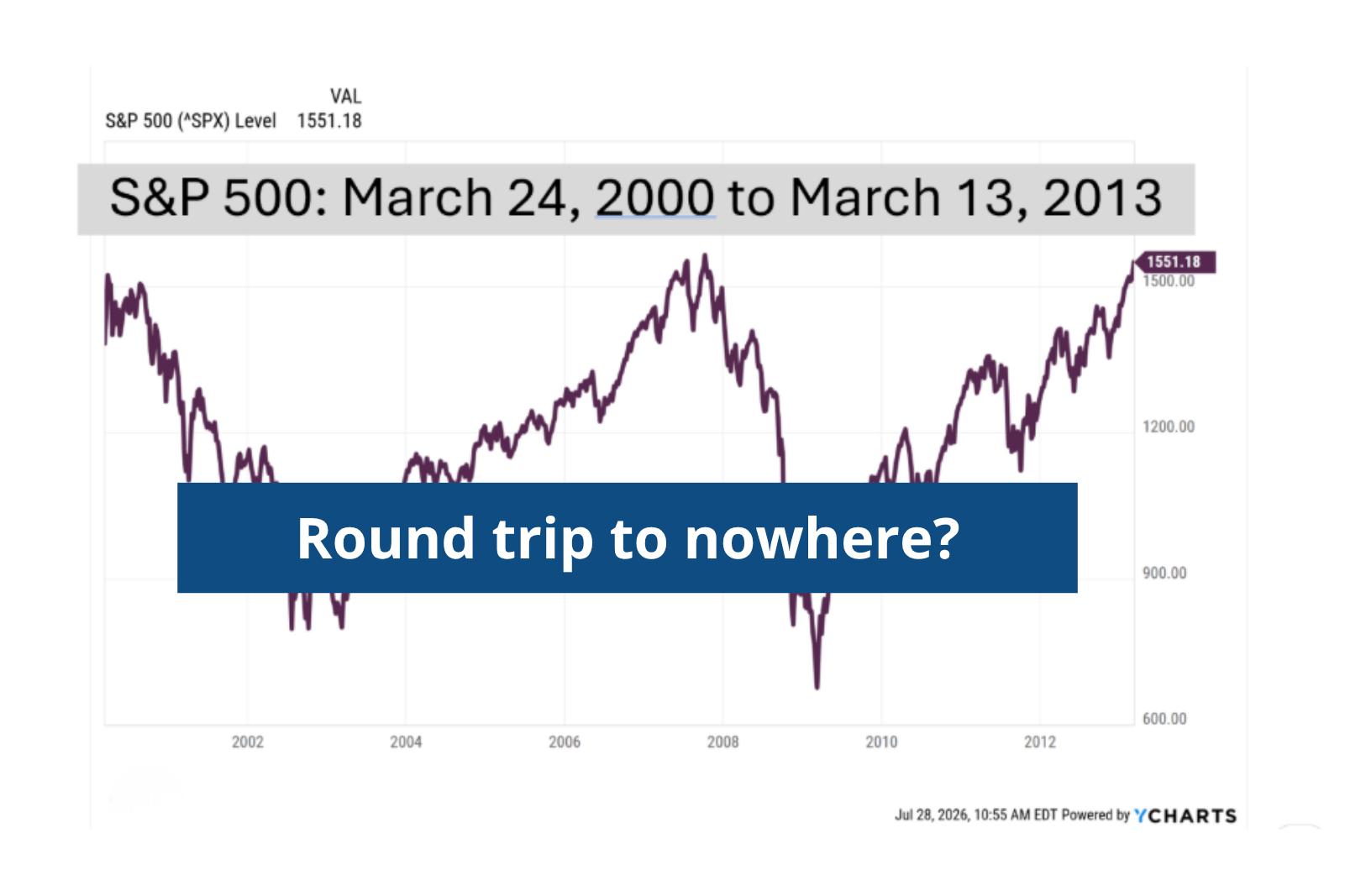
That was certainly the case in March of 2000, at the peak of the Internet Boom. The S&P 500 had basically tripled in five years and became dominated by large technology companies.
“The internet was going to change everything,” they said—and that story came true.
But valuations had gotten so excessive, the S&P 500 suffered a Lost Decade when the trend changed: it took nearly 13 years on a round trip to nowhere. Fortunately, the S&P 500, composed of the stocks of large U.S. companies, is not the only game in town. Small and mid-sized companies, value stocks, international companies, and other opportunities held up much better, sometimes even making gains during the flat spell.
This history lesson is key to why we are not chasing the index here at 228 Main, especially right now. Looking for bargains, avoiding stampedes—these fundamental principles help us avoid the extremes. Most of us don’t have thirteen years to wait for a market recovery, so it makes sense to strive to be in those parts of the investment universe that are more reasonably priced, now.
As in 2000, the index has become dominated by large technology companies, this time as part of the AI boom. We are paying attention to our principles, mindful that these trends may not persist.
We pay, temporarily, in performance. Our approach has us lagging the S&P 500 recently; we’re not going up by as much, but our efforts now are made in an attempt to potentially go down by less when the bust comes. No guarantees. But we’re turning to history as a guide.
Clients, now as ever, reach out any time with your questions. We’re here to help.
Neither the past performance of the S&P, nor the described methodology, is a guarantee of future returns.
Content in this material is for general information only and not intended to provide specific advice or recommendations for any individual. All indices are unmanaged and may not be invested into directly.
All investing involves risk including loss of principal. No strategy assures success or protects against loss.
Want content like this in your inbox each week? Leave your email here.
In Parks & Recreation, the heroine Leslie Knope knows exactly what she’s about: waffles, friends, work. No matter what, “work is last.” The thing is, Leslie loves work and loves being of service. She helps us remember why we work—and what we want for our relationships and our legacy.
Want content like this in your inbox each week? Leave your email here.
In the finance industry, you will find an abundance of acronyms. From IRA to RMD and everything in between, we don’t expect you to keep track of all the acronyms, but there is one we wanted to break down with you here: the ABLE account.
What are ABLE accounts? They are tax-advantaged savings plan or investment option for individuals with disabilities who qualify.
Who is eligible?
Individuals are eligible to open an ABLE account if their disability began before age 46 and they meet the required severity of disability in one of two ways:
Receiving Supplemental Security Income or Receiving Social Security Disability Insurance benefits, or
Having a licensed physician sign a document including the diagnosis and notes stating they have “marked and severe” functional limitations that began before age 46.
What’s the purpose? The goal is to take advantage of tax-free growth potential and allow beneficiaries to save for qualified disability expenses, such as:
Housing
Transportation
Health
Education
Another benefit of ABLE accounts is they do not affect eligibility for benefits like SSI and Medicaid. Lots of public benefit programs restrict eligibility to people with less than $2,000 in countable resources (like cash or retirement accounts). With ABLE accounts, up to $100,000 can be excluded as a countable resource.
ABLE plans available vary by state. It’s recommended to review the plan of the state where you live first because there may be tax deductions or credits available.
How are they opened and funded? ABLE accounts can be opened and managed by the beneficiary themselves, or if the beneficiary is under 18, another individual can be appointed to manage the account. Anyone can deposit money directly into the ABLE account, including the account owner, friends, or family. (Do keep in mind that the total ABLE plan balance limit is the same as the state’s limit for 529 plans, which varies.)
For those who need it, ABLE accounts can be a great resource. We believe that everyone should have access to investing and saving opportunities, and ABLE accounts are another option to consider when appropriate.
The market doesn’t discriminate, and neither do we. Clients, if you want to talk more about what options may be available to you, reach out any time.
For more information on this topic, visit the ABLE National Resource Center, managed by the National Disability Institute.
The opinions voiced in this material are for general information only and are not intended to provide specific advice or recommendations for any individual.
Investing involves risk including loss of principal. No strategy assures success or protects against loss.
This information is not intended to be a substitute for individualized tax advice. We suggest that you discuss your specific tax situation with a qualified tax advisor


You must be logged in to post a comment.